


The exhaust is the loudest single source on a generator set, and the silencer is the part that decides whether the installation meets its noise limit. Choosing it is not a matter of grade names: it is a balance between the attenuation the site needs, the back pressure the engine allows and the space the exhaust route has.
AXON supplies exhaust silencers for diesel and gas generator sets, alone or as part of a complete exhaust system with piping, expansion joints, insulation and stacks, for sets of any make. This page explains how a silencer is selected and what to settle before ordering one.
Where exhaust noise comes from
An engine exhaust carries two kinds of noise. The pulsations of the cylinders give a low-frequency rumble whose pitch follows the engine speed and the number of cylinders; turbulence in the gas stream and the flow out of the pipe end give broadband noise at higher frequencies. The first is the one that travels furthest and passes through walls; the second is the one people describe as hiss or roar close to the stack.
A silencer has to treat both, and the two call for different internal designs. That is why the sound data of a silencer is given per octave band and not as one number: a unit that performs well at high frequencies may do little against the low rumble that the neighbour complains about.
Silencer grades
The trade describes silencers by grade: industrial, residential, critical and hospital, in rising order of attenuation. The names come from the surroundings they were meant for - an industrial site that tolerates noise, a residential area, a critical site such as a hospital where the exhaust must be close to inaudible. Each maker publishes its own attenuation figures per grade, so two "residential" silencers are not necessarily equal.
A grade name is a starting point, not a specification. The specification is the sound level the site has to meet, at the distance where it is measured, and the exhaust silencer is one of three parts that decide it, with the acoustic enclosure and the air inlet and outlet silencers. We look at the three together: a hospital-grade exhaust silencer on a set whose cooling air openings are untreated does not give a quiet installation.
Reactive, absorptive and combined designs
A reactive silencer works with chambers and tubes: the gas expands into a chamber and part of the sound energy is reflected back. It is effective against the low-frequency pulsations and it keeps working over the life of the unit, because nothing inside it degrades.
An absorptive silencer passes the gas through a perforated tube surrounded by sound-absorbing material. It takes the high-frequency noise out and adds little resistance, but the material has to withstand the exhaust temperature and may need replacing after years of service.
Combined designs put both in one shell and are the usual choice for residential and critical grades. The right mix depends on the engine: a slow-running large engine has its energy low in the spectrum and needs the reactive part; a high-speed engine with a turbocharger has more of its noise higher up.
Attenuation against back pressure
Every silencer resists the gas flow, and the more attenuation it gives, the more it resists. The engine maker states the maximum back pressure the engine may see at the exhaust flange at rated load; above it the engine loses output, runs hotter and, in the worst case, is damaged. The silencer, the piping, the bends and the stack all add up against that limit.
A silencer is therefore never selected alone. The whole route is calculated: the length and diameter of the pipe, the number and radius of the bends, the expansion joints, the rain cap and the silencer itself, and a margin is kept for the fouling that comes with years of operation. Where the route is long, the pipe diameter goes up so that the silencer can keep its attenuation without pushing the total over the limit.
This is also why the exhaust route is asked for with the enquiry. Two bends more than planned can turn a correct silencer selection into an engine that does not reach its rated load.
Materials, insulation and mounting
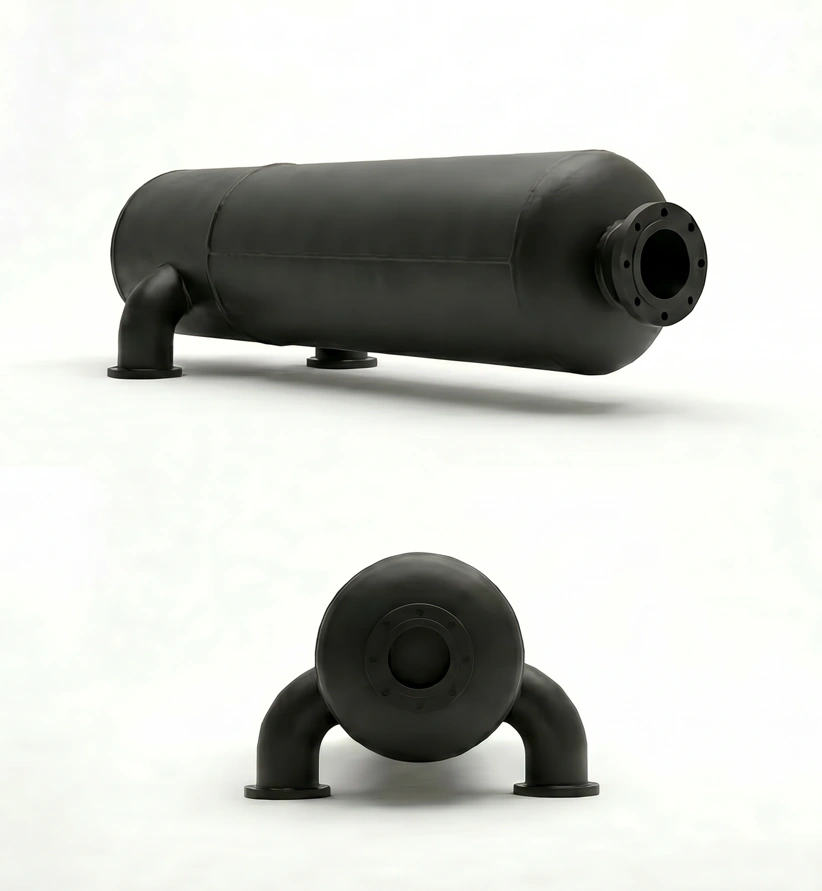
Silencer shells are made in carbon steel with a heat-resistant coating or in stainless steel, chosen for the gas temperature, the site atmosphere and the specification. Internals in contact with the hot gas are designed for thermal expansion; the shell carries lifting lugs and supports.
The silencer is mounted on supports or hung from the structure with flexible connections at the engine side, so that engine vibration is not carried into the pipe and the building. Thermal insulation on the silencer and the pipe keeps the surface temperature down inside the enclosure, protects personnel and reduces the noise radiated by the pipe wall itself. Condensate drains at the low points keep water out of the silencer during cold starts.
Silencers with SCR and in containers
Where emission limits call for an SCR system, the silencer and the SCR reactor are designed as one line: the reactor housing takes over part of the silencing, the dosing point sits where the gas is hot enough, and the total back pressure of both stays within the engine limit.
In a container or acoustic enclosure the silencer is mounted on the roof or inside the exhaust compartment, with the stack height and the outlet direction chosen so that the exhaust does not re-enter the cooling air inlet and the plume clears neighbouring buildings. The enclosure design, the exhaust and the air silencers come from AXON as one package.
What decides the selection
Three figures from the engine data sheet - exhaust gas flow, exhaust temperature and the maximum back pressure - the sound level the site must meet and where it is measured, and the route the pipe takes. With those, the silencer is selected from its octave-band data and the back pressure of the whole system is checked. Without them, a grade name is a guess.
What AXON supplies
- Exhaust silencers in industrial, residential, critical and hospital grades
- Reactive, absorptive and combined designs, carbon steel or stainless steel
- Complete exhaust systems: piping, expansion joints, flexible connectors, insulation, supports, rain caps, stacks
- Silencers combined with SCR systems for NOx reduction
- Air inlet and outlet silencers for enclosures and containers
- Back pressure check of the whole route with every selection
What to send with an enquiry
- Engine make, model and rating; exhaust gas flow, temperature and back pressure limit from the data sheet
- Sound level to be met and the distance or point where it is measured
- The exhaust route: pipe length, bends, stack height, indoor or outdoor
- Whether an SCR system is required
- Enclosure or container details, if the silencer is part of a package
- Material preference: carbon steel or stainless steel
Questions we are often asked
What is the difference between residential and critical grade silencers?
Critical grade gives more attenuation than residential, and hospital grade more again. The figures differ between makers, so the selection is made on the octave-band data against the site limit, not on the grade name.
Can a silencer be too good?
Yes. More attenuation means more resistance. A silencer that pushes the exhaust back pressure over the engine limit costs output and engine life. The silencer and the pipe route are checked together.
Reactive or absorptive?
Reactive silencers treat the low-frequency pulsations and do not wear; absorptive silencers treat high frequencies with little resistance. Most residential and critical silencers combine both.
Does the silencer alone make a generator quiet?
No. The engine, the cooling air openings and the exhaust each radiate noise. A quiet installation needs the enclosure, the air silencers and the exhaust silencer designed together.
Can AXON supply a silencer for an existing generator?
Yes. Send the engine data sheet, the sound level to meet and the exhaust route, and the silencer is selected and supplied with the connections of the existing pipe.
Stainless or carbon steel?
Carbon steel with a heat-resistant coating is the usual choice; stainless steel where the atmosphere is corrosive, the gas temperature is high or the specification asks for it.
Products
- Exhaust Silencers for Generator Sets
- Exhaust Gas System with SCR
- Air Inlet and Outlet Silencers
- Air Outlet Chimney
Further reading
- Generator Exhaust Silencer Grades Explained: Industrial, Residential, Critical and Hospital
- Exhaust Back Pressure: Why the Silencer and the Pipe Route Decide Generator Output
- Data Center Generator Emissions and Noise: SCR, Silencers and Acoustic Enclosures
- Exhaust and SCR Systems for Generator Sets
- Generator Set Containers and Enclosures