


A belly tank is the fuel tank built into the base frame of a generator set: the engine and alternator stand on it, and the whole package travels, lifts and runs as one unit. It is the most compact way to give a diesel generator its own fuel reserve, which is why most containerised and outdoor sets are ordered with one.
AXON designs and supplies belly tanks for diesel generator sets of any make, as part of a container package or as a stand-alone base frame delivered to the set builder. This page explains how a belly tank is specified, where it is the right choice and where a separate day tank serves better.
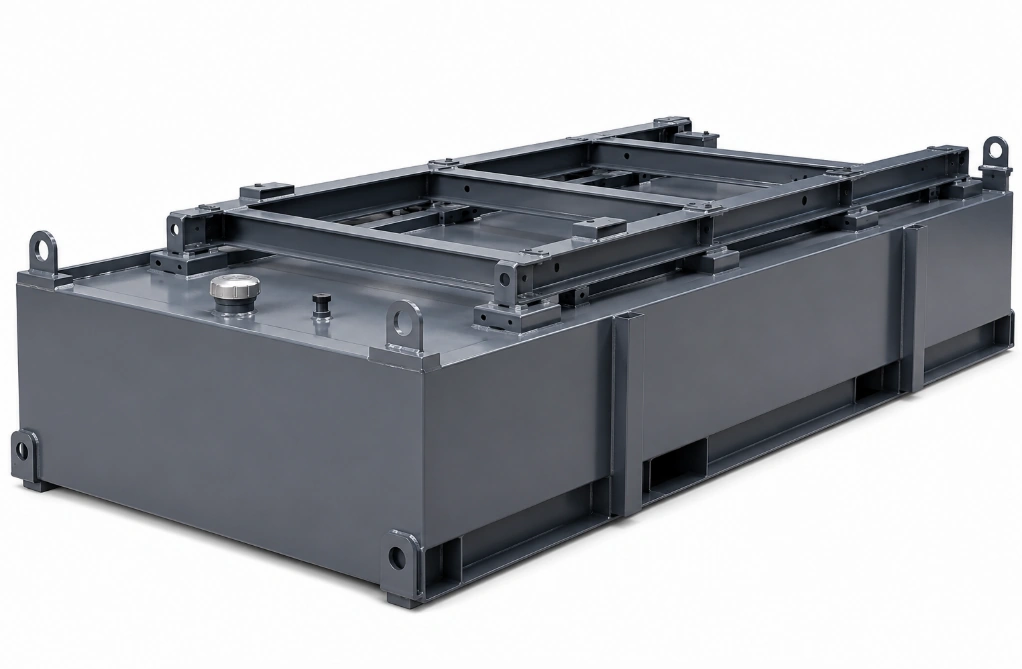
What a belly tank is, and what it is not
The base frame of a generator set normally carries the engine and alternator on anti-vibration mounts and gives the package its lifting points. In a belly tank the frame is built as a closed, welded tank: the fuel sits in the space under the engine that would otherwise be empty steel. The fuel outlet and return go up to the engine, the filling point sits at the side, and the set runs with no external pipework at all.
It is not a bulk storage tank. Its capacity is bounded by the footprint of the set and by the height a frame can have before the engine stands too high for service and transport. Where a site needs days of autonomy, the belly tank is the working reserve and a bulk tank feeds it.
It is also not the same thing as a day tank. A day tank is a separate vessel, usually fed by transfer pumps from bulk storage, placed where the plant layout wants it. The belly tank is part of the set; the day tank is part of the installation.
When a belly tank is the right choice
Standby and prime sets installed outdoors or in a container, where there is no fuel room and no space for a separate tank. The set arrives, is set down, filled and connected.
Rental fleets and sets that move between sites, because the fuel travels with the machine and nothing has to be installed at the new site.
Sites where the required autonomy fits under the set. For a standby set that must cover a few hours of outage, the belly tank alone is often enough. For prime power or a data center that specifies many hours at full load, the belly tank becomes the day tank of a larger system with bulk storage, transfer pumps and fuel polishing.
Noise-sensitive sites with an acoustic enclosure: the tank raises the set, which gives the enclosure its intake and exhaust routes under the floor level of the engine, and it adds mass that helps the enclosure stay quiet.
Capacity and autonomy
The capacity follows from two numbers the project has to give: the fuel consumption of the engine at the expected load, and the hours the set must run without a delivery. The engine data sheet gives the first; the owner, the operator or the design standard gives the second. From them the usable volume follows, and from the usable volume the tank.
Usable is the word that matters. A tank is never filled to the top, and the suction never drains it to the bottom: the filling margin, the ullage for expansion and the dead volume under the suction all come off the nominal capacity. A capacity quoted without saying whether it is nominal or usable is not a specification yet.
The frame sets the limit. A longer set gives a longer tank; a wider frame or a higher frame gives more volume but moves the engine up and the centre of gravity with it. When the autonomy does not fit, the answer is a bulk tank and a transfer system, not a frame that is too tall to service.
Construction: double wall, baffles, structure
A belly tank carries the generator set on its back, so it is a structural member first and a tank second. The walls are stiffened and the tank is baffled so that the fuel cannot surge from end to end when the set is lifted, transported or running on a tilted base, and so that the frame stays rigid under the engine and alternator.
Most specifications today ask for a double-walled tank: an inner tank that holds the fuel and an outer shell that contains any leak from it, with a monitored space between the two. The outer shell is sized to hold the full content of the inner tank, so that a failure of the inner wall never reaches the ground. Where a double wall is not required, a bunded floor or a drip tray under the set is the usual alternative inside a container.
Materials and coating are chosen for the site: a coastal or desert installation needs a different exterior than a plant room. Inside, the tank is designed so that it can be drained, inspected and cleaned, because stored diesel collects water and sludge over time, whatever the tank is made of.
Fittings and instruments
A belly tank is as useful as the connections and instruments it carries. The usual scope includes:
- Filling connection with a cap and, where the project asks for it, a lockable filling cabinet at the side of the set
- Vent pipe to a safe outlet, sized so that filling and emptying never pressurise the tank
- Fuel supply and return to the engine, with isolation valves
- Mechanical level gauge visible at the set, and level switches for low level, high level and overflow
- Overflow protection: a high-level switch that stops the transfer pump, or an overflow return to the bulk tank
- Leak detection in the space between the walls on a double-walled tank, wired to the control panel
- Drain valve at the low point for water and sediment, and an inspection opening for cleaning
- Connections for a fuel polishing system where the fuel will stand for long periods
The signals - levels, leak, overflow - are taken to the generator controller or to the auxiliary panel, so that a low tank or a leak is an alarm the operator sees and not something found at the next inspection.
Transport, lifting and site
A set with a belly tank is heavier and taller than the same set on an open frame, and the tank is usually empty for transport. The lifting points, the fork pockets where they are used and the tie-down points are designed for the package as it is shipped, and the filled weight is stated separately for the foundation on site.
On site the set stands on a flat, level base. A tank that stands out of level reads a wrong fuel level and can leave usable fuel below the suction at one end. Access to the filling point, the drain and the inspection opening is kept clear in the layout, also inside a container.
Belly tank, day tank or both
Short autonomy, one set, no bulk storage: a belly tank alone.
Long autonomy or several sets: bulk storage with a transfer system feeding either the belly tanks or separate day tanks. The belly tank then holds the working reserve and the bulk tank the autonomy. Fuel polishing keeps the stored fuel usable between outages.
Indoor plant rooms with fire-code limits on fuel inside the building: a small day tank near the engine and the bulk tank outside; the belly tank is sometimes not allowed, and the local code decides.
What AXON supplies
- Belly tanks as the base frame of a generator set, single or double wall
- Fittings: filling point, vents, level gauge and switches, overflow protection, leak detection, drains
- Integration with daily fuel tanks, transfer systems and fuel polishing
- Belly tanks inside AXON containers and acoustic enclosures, or as a stand-alone frame
- Materials and coatings for coastal, desert and industrial sites
- Drawings with lifting points, filled and empty weights for the foundation
What to send with an enquiry
- Generator set make and model, or the engine data sheet with the fuel consumption
- Required autonomy in hours and at what load
- Single or double wall; local rules on bunding and leak monitoring
- Where the set stands: outdoors, in a container, in a plant room
- Signals wanted at the controller or panel: levels, leak, overflow
- Transport route and crane capacity on site
Questions we are often asked
What is a belly tank on a generator?
The fuel tank built into the base frame under the engine and alternator. The set stands on it and carries its own fuel reserve, with no external tank or pipework.
How big can a belly tank be?
As large as the footprint and a serviceable frame height allow. Beyond that, a bulk tank feeds the belly tank through a transfer system.
Is a belly tank double-walled?
Usually, when the specification or the local rules require secondary containment. The outer shell holds the full content of the inner tank and the space between them is monitored for leaks.
Belly tank or day tank?
A belly tank is part of the set and suits outdoor, containerised and mobile sets. A day tank is a separate vessel placed where the installation needs it, fed from bulk storage. Many plants use both.
Can a belly tank be fitted to a set from any maker?
Yes. AXON designs the frame to the engine and alternator supplied, with the mounting points, the lifting points and the fuel connections the set needs.
Does stored diesel in a belly tank go bad?
Diesel that stands for months collects water and microbial growth. A drain at the low point, periodic sampling and, for standby sets, a fuel polishing system keep it usable.